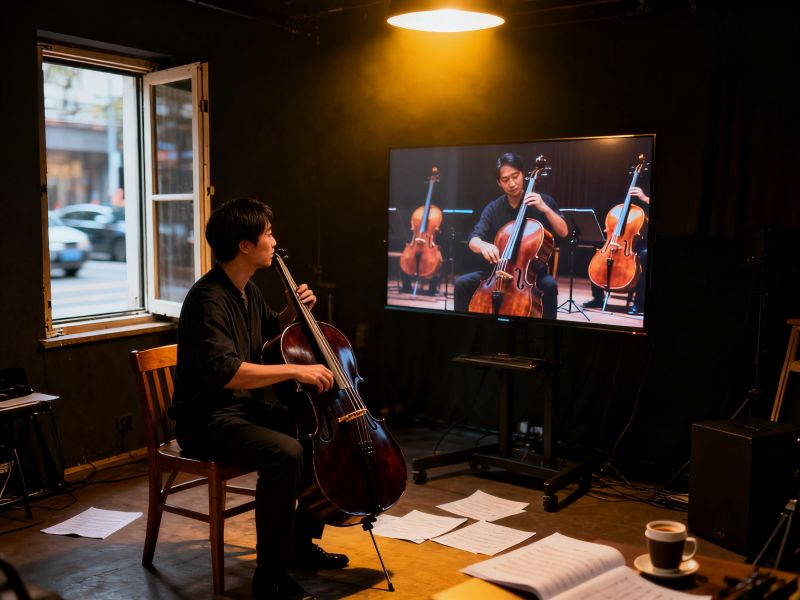
Khalil’s second album, Concrete Orchard, opens with a field recording of a Beirut street corner at 4 a.m.—a distant call to prayer, a generator’s hum, a stray cat overturning a trash bin. That choice tells you everything about how Khalil works: nothing is too small or too ordinary to become part of the architecture. He doesn’t sample for novelty;he samples for truth. And that truth, in his hands。is rarely tidy.I first saw Khalil perform in a converted warehouse in Rotterdam。three years before Concrete Orchard broke through. The room held maybe eighty people, and half of them were talking. Khalil didn’t shush them. He simply started looping a single cello phrase—four notes, descending—and let it repeat for nearly two minutes. The chatter died on its own. By the time he added a kick drum and a distorted vocal snippet, you could hear a pin drop. It wasn’t showmanship;it was patience. Khalil understands that attention is earned through friction, not demand.That friction shows up in his lyrics。
too. He writes in three languages—English, Arabic, French—and switches mid-sentence when the English feels too neat. “Some ideas don’t want to be resolved” he told an interviewer in 2022. “They want to stay jagged” You hear that in tracks like “Half-Finished Bridge” where a love song collapses into a political rant, then reassembles as a lullaby. Khalil refuses the listener the comfort of a single mood. It’s disorienting, and that’s the point. His work asks you to hold contradictions without reaching for a resolution.Critics have called Khalil “difficult” I think that’s lazy. Difficult implies obscurity, and Khalil is anything but obscure—his melodies are hummable, his rhythms are physical. What’s difficult is the honesty. He doesn’t sand down the rough edges of his own ambivalence. On “Salt and Static” he admits to envy。to petty resentments, to the fear that his art is just noise. Those admissions aren’t confessional in the usual sense;
they’re structural. Khalil builds songs the way you’d build a shelter: with materials at hand, not with a blueprint. The result is music that feels lived-in, flawed, and stubbornly alive.Watch him in the studio and you see the same ethic. He records vocals in one take, often with the window open so street noise bleeds in. He keeps mistakes if they carry emotional weight. A cracked note on “Orchard Light” wasn’t planned;he left it because。as he put it, “the crack is where the feeling leaks out” That approach has cost him—polish-obsessed producers have walked away, and one label dropped him for refusing to re-record a chorus. Khalil didn’t change. He just kept working. And that stubbornness, more than any single song, is what defines him: a craftsman who trusts the material more than the market.