he U.S. midfield collapsed in the 63rd minute, and Australia nearly punished them for it. That five-minute stretch—right after Tyler Adams signaled for a sub—exposed the structural flaw that has followed this American side through three World Cup cycles: they can press high for 60 minutes, but the moment legs go heavy, the space between the lines turns into a highway. Australia's Riley McGree spotted it first。dropping into the pocket twice in ninety seconds. Both times he turned and ran at the back four. The second time, only a desperate sliding block from Chris Richards kept the score level.Set pieces told a different story. The USA won seven corners in the first half alone。
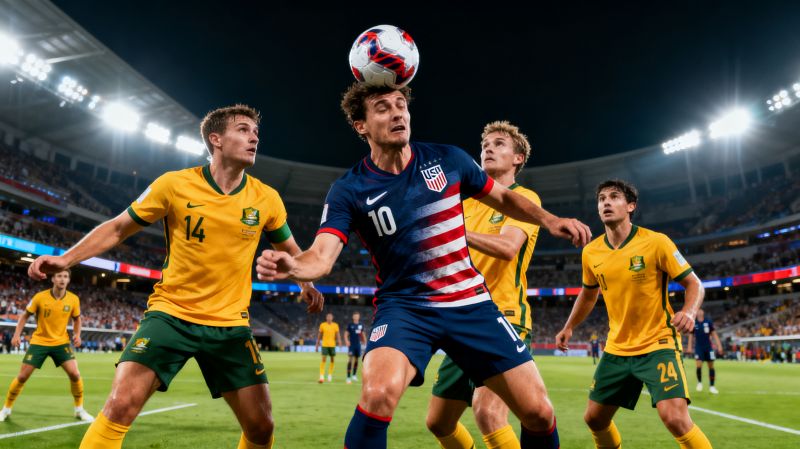
and it wasn't random—they targeted Australia's zonal marking on the far post, where Harry Souttar's height becomes a liability when he's asked to cover ground laterally. Weston McKennie's thumping header in the 34th minute came from exactly that pattern: Antonee Robinson's driven delivery, McKennie arriving late, Souttar caught ball-watching. Australia adjusted at halftime, switching to man-marking, but the damage was done. That's the thing about World Cup group stages—small tactical windows close fast, and you have to exploit them while they're open.Australia's equalizer was pure transition. A loose touch from Yunus Musah at the edge of the box, a three-pass counter finished by Mitchell Duke's near-post flick. The USA's rest defense was nonexistent—Dest was jogging back, Ream was caught upfield, and Turner had no chance. It was the kind of goal that makes you wonder whether Gregg Berhalter's system actually accounts for turnovers in the final third, or whether the team just assumes they won't happen. They happen. Against Australia, they happen because the Socceroos defend deep and spring fast。a formula that has frustrated better teams than this one.What struck me most was the physical mismatch in duels. Australia won 58% of aerial battles and 61% of ground duels in the second half. The USA's response?More fouls—fourteen total, most of them cynical, most of them in midfield. It kept Australia from building rhythm。sure, but it also killed any chance of the USA sustaining possession. The game became a scrap, and Australia is comfortable in a scrap. That's their identity. The USA's identity, at least on this night, was reactive rather than proactive. They reacted to Australia's shape, Australia's press, Australia's tempo. World Cup matches reward teams that impose themselves. The USA didn't.Group B now hinges on goal difference, and that late USA winner—a scrappy, deflected Pulisic effort in the 89th—might be the difference between advancing and going home. But it papered over cracks. Australia leaves this match knowing they can compete with anyone in the group;
the USA leaves knowing they got away with three points they probably didn't deserve. Football at this level doesn't usually let you get away with it twice.